

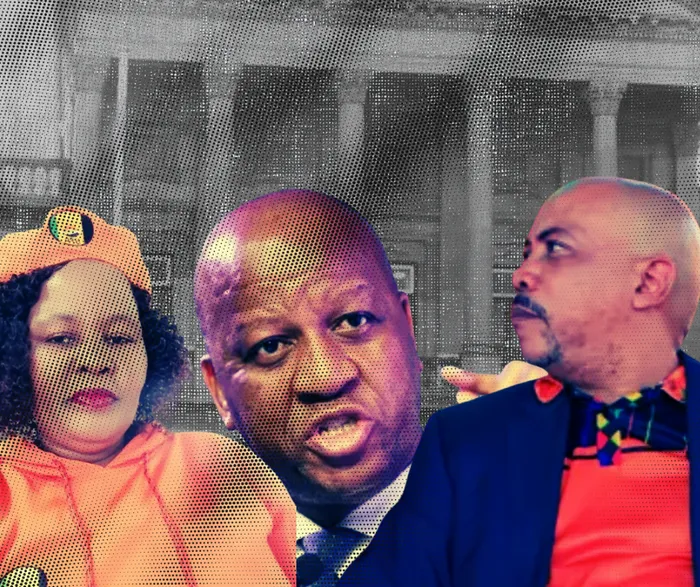
With just one seat in the 80-member legislature, the National Freedom Party (NFP) holds the balance of power needed to sustain the GPU. KwaZulu-Natal’s Government of Provincial Unity (GPU).
Image: IOL Graphics
THE National Freedom Party (NFP) was founded on 25 January 2011 by Zanele kaMagwaza-Msibi and a group of former Inkatha Freedom Party (IFP) members, marking one of the most consequential splits in KwaZulu-Natal’s post-1994 political landscape.
KaMagwaza-Msibi had joined the IFP in 1975 and rose steadily through its ranks, eventually becoming its national chairperson. However, by the late 2000s, relations between her faction and the party’s top leadership had soured.
Tensions peaked after the 2009 general election, when a reformist campaign, popularly branded “Friends of VZ", emerged to support her as a future IFP president. Her supporters were warned against openly wearing campaign regalia, signalling her growing marginalisation. The “Friends of VZ" seemed to the last straw for IFP traditionalists who saw her challenge for Prince Mangosuthu Buthelezi's position as sailing too close to the sun.
The rift deepened ahead of the IFP’s July 2010 elective conference. KaMagwaza-Msibi and senior leader Stanley Dladla were accused of backing the IFP Youth Brigade’s call for leadership change. Two of her prominent allies, Wiseman Mcoyi and Nhlanhla Khawula, were suspended months earlier for inflammatory remarks made during her swearing-in as a member of the KwaZulu-Natal Legislature. After more than two years of internal strife, she broke away from the IFP and launched the NFP.
Despite being barely three months old, the NFP made a stunning electoral debut in the 2011 local government elections, securing 2.4% of the national vote and a formidable 11.1% in KwaZulu-Natal. Its rapid rise fuelled allegations that it was an ANC project designed to weaken the IFP, claims the party consistently denied.
The NFP consolidated its presence in the 2014 general election, winning seats in both the National Assembly and the KZN Legislature. In June that year, then-President Jacob Zuma appointed kaMagwaza-Msibi as Deputy Minister of Science and Technology. While the ANC framed the move as inclusive governance, critics, particularly the DA and the IFP, condemned it as political co-optation.
The party’s trajectory shifted dramatically in 2021 when kaMagwaza-Msibi died after years of incapacitation following a stroke. Leadership fell to the national executive committee, with secretary-general Canaan Mdletshe, a former KZN journalist, becoming the party’s public face.
In December 2023, Ivan Barnes was elected NFP president after a closely fought contest against Zandile Myeni, winning 208 votes to 190. Though the result was disputed internally, the Electoral Commission ultimately cleared Barnes. A longtime party activist from the former uThungulu District, Barnes had cut his political teeth in the early 2000s as president of the IFP-aligned South African Democratic Student Movement (SADESMO).
In May 2024, the newly formed uMkhonto weSizwe Party (MKP) emerged as the largest party in the KZN Legislature after the polls, prompting intense coalition negotiations. When the NFP opted to support an IFP-ANC-DA Government of Provincial Unity (GPU), Mdletshe resigned in protest and defected to the MKP.
Speculation soon mounted that Barnes had been promised the Zululand mayoral position, left vacant after Thulasizwe Buthelezi’s appointment as MEC for Cooperative Governance and Traditional Affairs. The position never materialised, and Barnes’ leadership has since been beset by deepening internal divisions. These tensions erupted in mid-2025 after he failed to recall provincial chairperson Mbali Shinga, also the MEC for Social Development and the NFP’s sole MPL.
Now, as Barnes considers withdrawing the NFP from the GPU while simultaneously attempting to discipline and recall Shinga without the full NEC backing, his isolation has intensified. Calls for his removal are growing louder. Mid-week, Barnes came close to exchanging blows with one of the NFP mayors, in an expletive-laden confrontation at a hotel lobby where Shinga's disciplinary hearing was underway. This weekend, GPU partners are making a last-ditch effort to persuade the NFP to remain within the governing arrangement.
With just one seat in the 80-member legislature, the NFP nevertheless holds the balance of power needed to sustain the GPU. Whether Barnes will resist overtures from an MKP-EFF pact may depend on whether a more compelling political incentive emerges from the GPU, a carrot probably larger than the elusive Zululand mayoral chain. For now, amid public spats, expletives and even fisticuffs, the party’s lone seat, and its leadership, rests on an increasingly rickety foundation.