

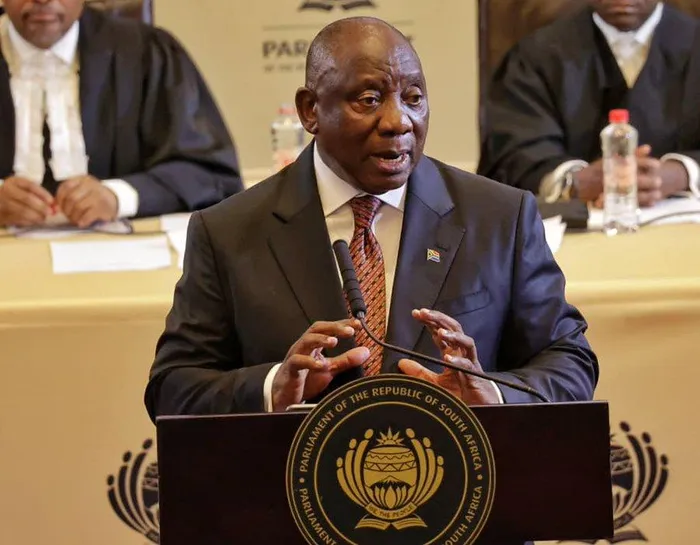
As President Cyril Ramaphosa prepares for to deliver the 2026 State of the Nation Address at the Cape Town City Hall on Thursday at 7pm, South Africa under the Government of National Unity stands at the crossroads with many problems like high youth unemployment, water crisis, untransformed economy, poor service delivery and a public sector bedeviled by corruption.
Image: GCIS
When President Cyril Ramaphosa steps up to the podium at Cape Town City Hall this Thursday evening, he will do so under the banner of constitutional symbolism and coalition pragmatism. It will be his second SONA under the Government of National Unity (GNU), and perhaps his most politically delicate yet. The question is not whether he will deliver a speech, he will. The question is whether the speech will deliver anything beyond reassurance.
South Africa is not yet in a fatal crisis. But it is not in recovery either. It is suspended between structural stagnation and technocratic optimism, between coalition arithmetic and popular disillusionment. And Ramaphosa, ever the cautious steward, must now convince a weary nation that stability is not the ceiling of ambition.
Promises Made, Promises Managed
Last year’s SONA was heavy on reform rhetoric. Ramaphosa promised to “put the risk of load shedding behind us once and for all.” That promise, to his credit, has materialised. As of this week, South Africa has gone 266 consecutive days without load shedding. Operation Vulindlela, the Electricity Regulation Amendment Act, and the launch of the National Transmission Company have delivered the GNU’s crown jewel: energy stability.
But beyond the grid, the picture blurs.
Transnet’s promised turnaround remains sluggish. The Durban Container Terminal Pier 2 concession was signed, but private rail operators are still stuck in certification limbo. The “second wave of reform” has yet to crash ashore.
The Electronic Travel Authorisation system was rolled out, boosting tourism from G20 markets. But GDP growth remains anaemic. Hovering between 1.2% and 1.5%. The 3% growth target, once framed as a “virtuous cycle,” now looks like a distant mirage.
The water crisis, declared a national priority last year, continues to cripple municipalities including our biggest metro, Joburg. Ring-fenced utilities for water and electricity were promised. Yet many local governments remain under-resourced, mismanaged, and structurally broken. The review of the local government white paper and funding model is underway but the man on the street still queues for water.
The GNU: Stability Without Substance?
Since the 2024 elections, the GNU has delivered political stability. The ANC, bruised but still dominant, leads a coalition stitched together from ideological fragments. Ramaphosa has managed to sanitise this incoherence into a virtue: “unity,” “pragmatism,” “whole-of-government alignment.”
But stability is not transformation. And the GNU’s performance has yet to translate into meaningful change for ordinary South Africans.
Youth unemployment remains catastrophic. Real disposable income has declined. Township economies are stagnant. The “green shoots” narrative of improved energy, modest job creation, an S&P credit rating upgrade is politically curated. It masks a deeper malaise: a growth model that enriches established capital while leaving the majority behind.
Ramaphosa’s political footing within the GNU is secure, but brittle. He is the coalition’s anchor, but also its constraint. Bold moves risk rupture. Disruption is deferred. And so the presidency performs governance, rather than enacting it.

A member of the community walks away with a bucket full of water from the water tanker in Johannesburg where many areas have been without water for more than a week in a province-wide outage. The outages have sparked widespread protests. The water tankers have become a familiar sight and permanent feature in many communities around South Africa as the water crisis spreads. The writer argues that President Cyril Ramaphosa's State of the Nation Address needs to come up with long-term solutions for South Africa's water crisis.
Image: TIMOTHY BERNARD Independent Newspapers
What to Expect from SONA 2026
Expect a speech heavy on continuity. Ramaphosa will cite energy gains, logistics reforms, visa modernisation, and Operation Vulindlela’s technocratic victories. He will reaffirm the Medium-Term Development Plan’s priorities: inclusive growth, poverty reduction, and a capable state.
He will speak to youth on dignity, skills, and jobs. He will nod to crime. Hopefully announce a permanent Police Minister. He will mention water and the need to fix local government. He will invoke constitutionalism, multilateralism, and South Africa’s place in the world.
But he will not disrupt. He will not announce a radical overhaul of the economic model. He will not confront the coalition contradictions that dilute policy coherence. He will not speak to the structural inequality that defines South African life.
The Politics of Pretence
Ramaphosa’s SONAs have followed a script: diagnosis without disruption, reform without rupture. SONA 2023 acknowledged the crisis. SONA 2024 offered populist pledges. SONA 2025 sanitised coalition compromise. SONA 2026 will likely continue the pattern. The performance of stability over the substance of transformation.
This is not a failure of character. It is a failure of political imagination.
South Africa does not need more reassurance. It needs disruption. It needs a growth model that includes the excluded. It needs a state that delivers. It needs leadership that risks rupture for the sake of renewal.
The Moment Demands More
SONA 2026 arrives at a pivotal moment. The GNU has stabilised the political terrain. The energy crisis has been managed. The machinery of reform is turning.
But the man on the street is still waiting.
Waiting for water. Waiting for work. Waiting for dignity.
Ramaphosa must decide: will he offer courage or continuity?
(Dube is a noted political economist, businessperson, and social commentator on Ukhozi FM. His views don't necessarily reflect those of the Sunday Tribune or IOL. For further reading and perspectives, visit: http://www.ncodube.blog)