

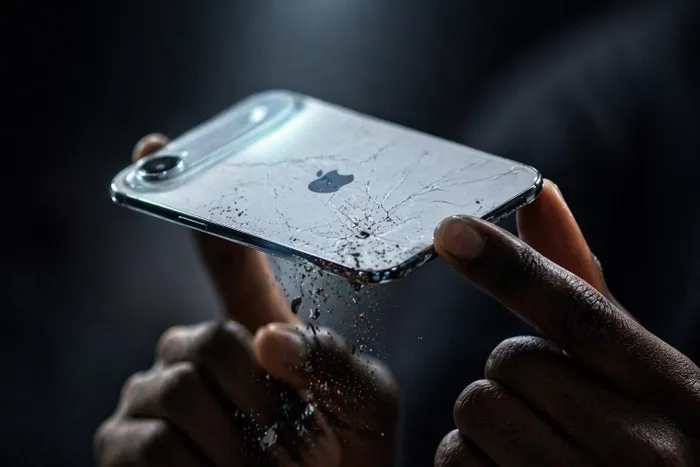
The iPhone Air, launched in September, has been the worst-selling model in Apple’s latest lineup due to its inexcusable hardware limitations, such as poor battery life requiring an external MagSafe battery, despite its sleek design and premium price. Picture: NIC COURY / AFP/ChatGPT
Image: NIC COURY / AFP/ChatGPT
Since the new iPhone Air launched in September, it’s been the worst selling phone among the latest range released by Apple, and it’s no surprise really.
If you’ve been in the Apple ecosystem for any length of time, you know that they are experts at luring you in to buy an inferior product at a premium, and that’s exactly the case again with the iPhone Air.
The new, thinner, very slightly lighter phone was launched alongside the iPhone 17 range.
It means there are now five different ‘new gen’ models to choose from, which are the iPhone 17, iPhone Air, iPhone 17e, iPhone Pro, and iPhone Pro Max.
Once again, it’s a convoluted lineup, but what stands out for me is the iPhone Air.
Like the MacBook Air and iPad Air, Apple has once more introduced a thinner, lighter product in the lineup that looks aesthetically pleasing.
However, unlike the current MacBook Air and iPad Air, there are a number of inexcusable hardware limitations with the first of its kind iPhone Air.
This is best demonstrated by the fact that alongside the new iPhone Air, Apple will now be offering a custom-made MagSafe (magnetic) external battery which clips onto the phone.
You heard that right, to get better battery performance on par with the other current iPhones, a user will have to essentially carry a power bank as well? For me, that’s just counter-intuitive and simply ludicrous.
Without the external battery, the Air has the worst battery life among the 17 lineup with up to 30 hours of playback according to the Apple website, but that’s in their own tests and not real-world use. In their presentation of the Air, it also said “all-day battery,” which is really vague and difficult to prove or disprove.
Of course, it is noticeably thinner at 5.64mm thick compared to the base model iPhone 17, which is the next thinnest at 7.95mm thick. The Air also comes in at 165g, while the 17 is 12g heavier at 177, which is an indistinguishable weight difference.
The comparison with the iPhone 17 is the most relevant, since the Air retails at R21,999. The iPhone 17 will be R2000 cheaper, and though the display is slightly smaller at 6.3” compared to the Air’s 6.5”.
In every other aspect, the iPhone 17 bests the Air, with a much better camera system probably the biggest advantage. Like the iPhone 16e, the iPhone has just one 48MP main camera on the back, while every other model has multiple lenses, most notably the extremely useful widescreen for any kind of outdoor pictures or videos.
* The views expressed are not necessarily the views of IOL or Independent Media.
** JOIN THE CONVERSATION: Send us an email with your comments, thoughts or responses to iolletters@inl.co.za. Letters should be a maximum of 500 words, and may be edited for length. Anonymous correspondence will not be published. Submissions should include a contact number and physical address (not for publication).