

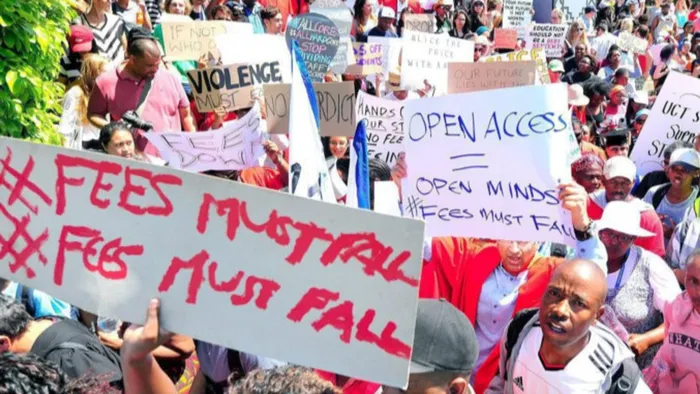
In 2015, students staged nationwide protests in support of the #FeesMustFall campaign.
Image: File picture: Henk Kruger
It has been ten years since students at the University of the Witwatersrand sparked what would grow into a national uprising under the banner of Fees Must Fall. The movement was bold, unrelenting, and at times chaotic, but it was necessary.
It revealed the deep cracks in South Africa’s higher education system and demanded that education become a right, not a privilege. A decade later, we must ask ourselves a difficult question: what has really changed? The Fees Must Fall movement achieved some notable wins. Most prominent among them was the announcement in 2017 by then-president Jacob Zuma that the government would implement free higher education for poor and working-class students. This led to a significant expansion of NSFAS, offering funding to students who would otherwise have no access to tertiary education.
But today, many of the issues that ignited the protests still remain. Students are still excluded due to financial reasons. Every year, headlines report that thousands are denied registration due to outstanding fees. Students are still forced to protest for housing, meals, mental health support, and basic dignity on campuses across the country. It is hard to call this progress when the core problem — inequality — is still very much alive within the university system.NSFAS, which was once seen as the solution, has become part of the crisis.
The scheme is marred by poor administration, payment delays, policy confusion, and allegations of corruption. In 2023 and 2024 alone, students were defunded mid-year, with little explanation. Appeals processes are opaque, and communication is often non-existent. For many, the experience of dealing with NSFAS has become a trauma of its own — a new form of exclusion in the guise of inclusion.
Even more disappointing is how many of those who once marched at the frontlines of Fees Must Fall have now moved into positions of power — in Parliament, in provincial governments, in student representative councils — and have gone quiet. Some have traded in their protest slogans for parliamentary silence. The movement, in part, has been co-opted. Leadership that once challenged the system now seems comfortable within it. Of course, not every activist who joined Fees Must Fall sought power for personal gain. Many remain committed to justice. But the reality is that the movement's momentum has been diluted.
A once-radical call for the decolonisation and transformation of education has, in many ways, been reduced to bureaucratic reforms and elite politics. The truth is that Fees Must Fall was never just about fees. It was about access, yes, but also about the quality of education, the culture of universities, and the very idea of who belongs in these spaces. Ten years on, universities remain alienating for many Black, working-class, first-generation students. Curricula are still Eurocentric. Support systems are minimal. Racism, classism, and sexism remain embedded in university culture and administration. The promise of transformation feels more like lip service than reality. Graduate unemployment also paints a bleak picture. Many who fought for access now hold degrees but no job opportunities.
Education was meant to be a pathway out of poverty, yet for many, it has become a holding space — a delay, not a solution. What we are left with is a contradiction: more students are in university than ever before, but the system is still fundamentally unequal. We have more policies in place, but less political will to implement real change. We have more student leaders in Parliament, but fewer voices holding power to account. The tenth anniversary of Fees Must Fall should not just be a commemoration. It should be a moment of deep reflection. The movement taught us that change is possible when people organise, but also that change is fragile. Without accountability, without sustained activism, without a commitment to justice beyond rhetoric, progress stalls.
The question now is not just what has changed, but what must still be done. We need a renewed focus on equity in education, honest conversations about the failures of government and institutions, and student movements that are not easily absorbed into the very systems they seek to disrupt. Ten years ago, students across the country declared: “We are not fighting for ourselves, we are fighting for generations to come.” That generation is now here - and the fight is far from over.
*Mayalo is an independent writer and the views expressed are not necessarily those of IOL or Independent Media.