

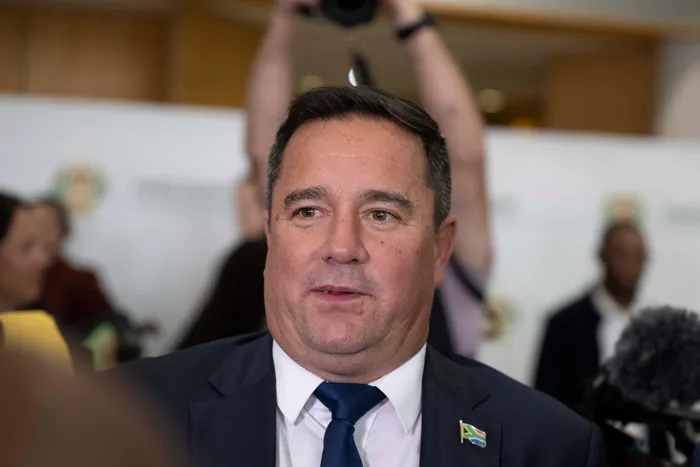
DA leader John Steenhuisen is under pressure over revelations of a default judgment in May for nearly R150000 in unpaid personal credit card debt.
Image: Henk Kruger/Independent Newspapers
There’s something deeply confusing about how our so-called Government of National Unity is functioning, or rather, not functioning. The Democratic Alliance (DA) walks around as if it’s doing South Africa a favour by being part of the GNU, yet at every turn, it behaves like the opposition. It’s as if they’ve forgotten they are part of the very administration that’s supposed to fix the mess.
You can’t claim to be in government on Monday and then hold the country hostage by Thursday because you don’t like a decision that doesn’t go your way. The DA’s behaviour lately feels less like governance and more like political theatre, a performance for their base, rather than a commitment to collective leadership. When the GNU was announced, many South Africans, myself included, thought maybe, just maybe, this was a moment for maturity in our politics. Different parties, different ideologies, one shared goal: to stabilise the country and get things moving again. But what we’re seeing is a DA that acts as if it’s standing outside the Union Buildings, not sitting inside the Cabinet room.
You can’t have it both ways. If you’re in government, you govern — you don’t cherry-pick when to be a partner and when to be a critic. Yet that’s what the DA keeps doing: threatening to walk out, grandstanding on policy issues, and then crying foul when things don’t go its way. It’s holding the GNU hostage to its own brand of politics — one that seems more interested in scoring points than solving problems. And here’s what’s even more worrying: while the DA throws tantrums and the ANC tries to keep the peace, it’s always Cyril Ramaphosa’s administration that takes the blows. Every time there’s a public backlash, it’s Cyril who must explain, apologise, or defend decisions — even those influenced or co-signed by the DA. It makes you wonder: is there a silent understanding between the two sides? Has the DA struck a behind-the-scenes deal that allows them to benefit from power while distancing themselves from accountability?
Think about it. When there’s praise to be claimed, the DA is quick to remind everyone that their “influence” made it happen. But when there’s failure, they point fingers straight back at the ANC. That’s not partnership — that’s manipulation. And it leaves the country confused about who’s actually steering the ship. The DA enjoys the perks of power but doesn’t want the burden that comes with it.
Meanwhile, Ramaphosa keeps absorbing the political heat. It’s as if the GNU is built on the logic that the President must be the national punching bag while coalition partners play clean. Maybe that’s the deal — keep the DA happy, keep the GNU intact, and let Cyril take the shots to protect the illusion of unity. But unity built on silence and imbalance isn’t unity at all. It’s survival politics, and South Africa deserves better than that.
The truth is, this arrangement can’t hold forever. The DA can’t continue acting like it’s the adult in the room while throwing its toys out of the cot every time a compromise is required. Coalition politics are messy — that’s a given — but they require trust and shared accountability. If the DA wants to be seen as a serious governing partner, it needs to stop pretending it’s still in opposition. You can’t campaign on “clean governance” while playing political games behind the scenes. South Africans are watching. We can see through the spin.
We can see who’s doing the work, who’s ducking responsibility, and who’s quietly cutting deals to stay relevant. The GNU was supposed to be a symbol of renewal, of a country finally growing up politically. Instead, it’s starting to look like a marriage of convenience — one where everyone wants power, but no one wants blame. At some point, the DA must decide: is it in or out? Is it ready to govern with integrity and compromise, or will it keep pretending to be opposition while sitting in Cabinet meetings? And Cyril Ramaphosa, for his part, must stop taking all the political bullets. Leadership is about fairness — and fairness means calling out those who undermine the spirit of unity for their own political gain .Until that happens, the GNU will remain fragile — a partnership in name, but a battlefield in practice. And once again, it’s ordinary South Africans who’ll pay the price for politicians who can’t decide whether they want to lead or just perform.