

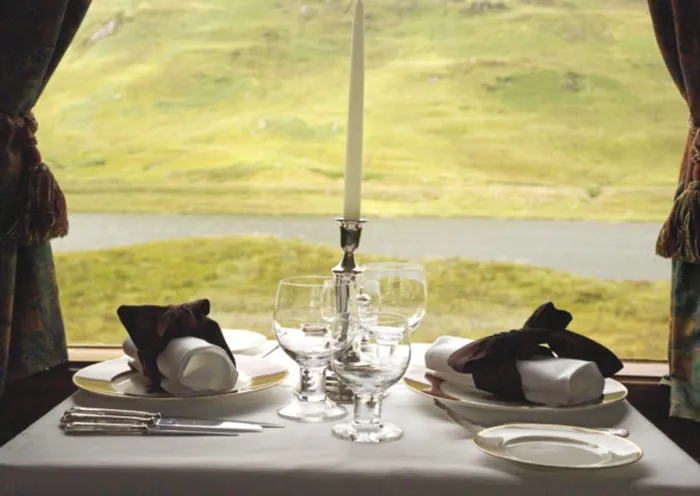
The Royal Scotsman -- View from Dining Car Picture: Giles Christopher Used for feature in Verve, The Star. The Royal Scotsman -- View from Dining Car Picture: Giles Christopher Used for feature in Verve, The Star.
London - It was little more than an egg in a cheap, floury roll, but it counts as one of my best meals. The aperitif was a 25-year-old Islay malt whisky and the dessert came from a bag of jaw-breaking Soor Ploom sweeties.
The ever-changing view was from the engine cab of the Royal Scotsman luxury train: buzzards soaring above deer on heather-clad hills, lochs and waterfalls, and a necklace of islands glistening in the distant Inner Hebrides.
Best of all, though, was the egg – laid that day and fried on the blade of a coal shovel, red hot from the firebox, as the train wound through glens and mountains towards Scotland’s west coast.
On board was the young head chef Andrew Fairlie who, two decades later, became the only holder of two Michelin stars north of the border, for his eponymous restaurant at Gleneagles hotel.
He says: “It only goes to show that while food is the most important element in any restaurant, it is not the be-all and end-all. Atmosphere is essential, too. At Gleneagles, we’ve got one of the world’s finest golf courses on our doorstep, and on the Royal Scotsman train the magnificent scenery changes every minute. I love the mountains, especially.”
Fairlie, now 48, spent two seasons on the Royal Scotsman, despite an inauspicious start. “In my second week, the train set off without me at Fort William and no one noticed. It took a two-hour taxi chase to catch up with the train.”
When not at the stove, Fairlie, 49, is a keen hill-walker. He has climbed Mount Kilimanjaro and bagged almost 40 Munros, Scotland’s mountains over 3 000 feet.
His predecessor on the Royal Scotsman, Andrew Radford, 55, is also a Munro-bagger, almost 60 so far. “The main advantage, enjoyed by no other restaurant,” says Radford, “is that we could buy the best ingredients as we went: seafood caught that day and game fresh from the moor.”
Following Radford and Fairlie in 2002/03 was Craig Wood, who has won plaudits, including a Michelin recommendation, for his Wee Restaurant in North Queensferry, Fife.
Wood, 40, says: “The galley kitchen is only about six metres long. There is a narrow passage, scarcely half a metre wide, between six burners, stoves and work space on one side and fridges and a sink on the other. You quickly learn how to be efficient at ordering supplies, planning menus – and improvising.
“Once, arriving late at the railhead on Kyle of Lochalsh pier on the west coast, we had to make a quick turnaround before serving lunch – and the fridge was bare. I called our local fisherman, Neil McRae, on his mobile. He was out on his boat. He drew alongside the pier, jumped on to the train with a sack of hand-dived scallops and within minutes he was helping us open them. We served them with a wild leek butter sauce. His wife had to drive to pick him up a few stops down the line. You don’t get shellfish fresher than that.”
Cooking in the tiny galley kitchen, where current head chef Mark Tamburrini, 39, is now in his fourth season, poses challenges. “My first month was the hardest work I’ve ever done, but you learn quickly.” he says.
“Beware the emergency stop. It happened once when we were about to serve lemon posset. They flew everywhere. One menu had a choice of three starters, but the 36 on that trip had different likes and dislikes, as well as dietary requirements, so I ended up making 16 different starters. Royal Scotsman guests expect service like that.”
Don’t serve soup while on the move is a golden rule. The train is prone to shoogle, a Scottish word meaning to shake or wobble. But a perfect panna cotta, the Italian dessert which Tamburrini flavours with whisky, should be capable of a distinct tremble. So a Royal Scotsman shoogle adds a theatrical bonus.
Travelling on this luxury train requires deep pockets. “But for your money you get the best scenery you could wish for, and it certainly gets you in the mood for dinner,” said one American in the observation car on my journey more than quarter of a century ago. As we responded to the magic words “Last call for dinner,” he added: “God may have spent six days organising the world, but on the seventh he must have decided that small was beautiful and chose to play at trains in Scotland.”
Acrobatic waiters slalomed between passengers in evening dress and kilts in the two dining cars. Fairlie conjured up fresh asparagus with Beluga caviar, calves’ sweetbreads with sherry, local seafood including salmon, halibut, langoustine and turbot with a saffron beurre blanc, Aberdeen Angus beef with wild mushroom sauce, and home-made ice cream.
Steam power no longer features on the journey, and health and safety regulations today would not allow passengers to fry an egg on a shovel. But Scotland’s scenery is timeless, and the choo-choo chefs continue to work magic with the finest Scotland has to offer from sea, sky, field and moor.
l The Royal Scotsman season runs from April 21 to mid-October. The four-night Classic Journey costs £4 330 (R59 000).
l royalscotsman.com
Mark Tamburrini’s whisky panna cotta
475ml of double cream
120ml milk
100g of castor sugar
2 sheets of gelatine
1 vanilla pod
1 measure of whisky
1 Add milk, cream, sugar, whisky and the vanilla to a large pan and bring to the boil. Stir well to dissolve the sugar. Soak the gelatine in cold water until soft,squeeze out excess water and dissolve in cream mixture.
2 Remove pod and pass cream mix through a sieve into a bowl. Chill by placing the bowl in cold water until nearly set.
3 Fill moulds with the mixture and cover with cling film. Place in fridge to set for three to four hours.
4 Dip the moulds in a bowl of warm water for up to 10 seconds to release. Don’t leave in the water long enough to melt. Turn on to plates. Serve with raspberry sorbet and oatmeal tuiles. – The Independent