

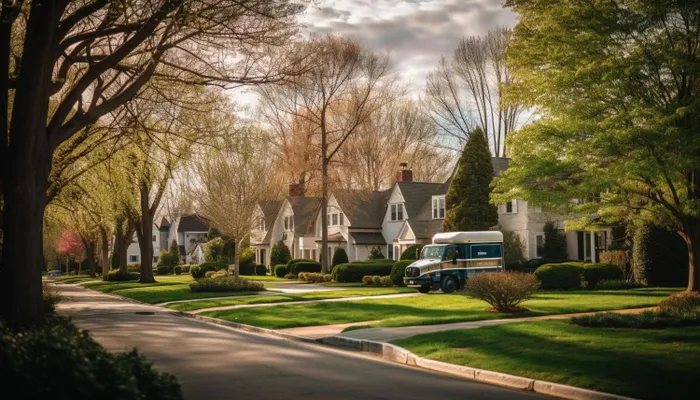
A clip shared by a South African living in the US, featuring quiet suburban streets, has ignited an online debate. The discussion centres on the contrasting experiences of neighbourhood life, focusing on themes of safety and personal freedom compared to South Africa.
Image: Magnific
A South African man living in the United States has sparked strong debate online after sharing an X clip showing the neighbourhood near his workplace.
Jason Bartlett’s video captures wide, quiet, clean streets lined with large homes and lush lawns, but what stood out most was the absence of visible security.
No electric fences. No razor wire. No boomed entrances. No armed guards. For Bartlett, the contrast with South African suburbs was hard to ignore. He described what he saw as a version of everyday safety.
“Do you see what I see? I see freedom and safety. I don’t see 12 ft fences, with 3 ft of electricity on top of it. There’s no security guard; this is just the norm.” His comments opened up a wider conversation, with social media users weighing in from very different angles.
Some agreed with his perspective, seeing the clip as a glimpse into a more open way of living. Others, however, argue that his experience is location-specific and not representative of the broader United States.
One user wrote: “This is because you're lucky that you were sent to red Alabama. If you'd ended up in a blue city, it'd be entirely different ... crime, illegals, homeless, filth, drugs, etc.”
In American politics, “red” refers to the Republican Party, which is generally conservative. “Blue” refers to the Democratic Party, which is generally liberal.
The user is basically suggesting that Bartlett’s little “peaceful streets with no fences in sight” moment might not be the full American picture, but rather a very specific setting.
By calling it “red Alabama”, they’re pointing to a conservative, Republican-leaning, often more rural kind of environment where life can look a bit slower, quieter, and yes, a lot less hectic than the big-city chaos people usually associate with the US.
The subtext here is doing a lot of work. It’s basically saying: don’t get too carried away thinking this is what every corner of America looks like.
From there, the conversation pivots back to South Africa, where the idea of safety looks very different in practice.
One visitor shared their reaction after spending time in the country: “I went to SA with my Afrikaner hubby back in 2016. The levels of security at EVERY house was shocking..sometimes a big gate INSIDE the house to the bedrooms that would be locked at night.”
Another comment went deeper, linking security directly to the decision to leave: “I asked my one brother why he left South Africa in the 90s? Both were fully employed. Both were doing well.
"They couldn’t afford to stay. Been burgled twice, and they could not get homeowner’s insurance without signing up for Armed Response Security. They’re retired in Perth now.”
Put together, the responses strip the debate down to something more honest. Bartlett’s video shows a quiet, open suburb that feels almost unreal when compared to South African norms.
But the replies remind us that both places are shaped by context, whether that’s political geography in the US or lived experience in South Africa.