

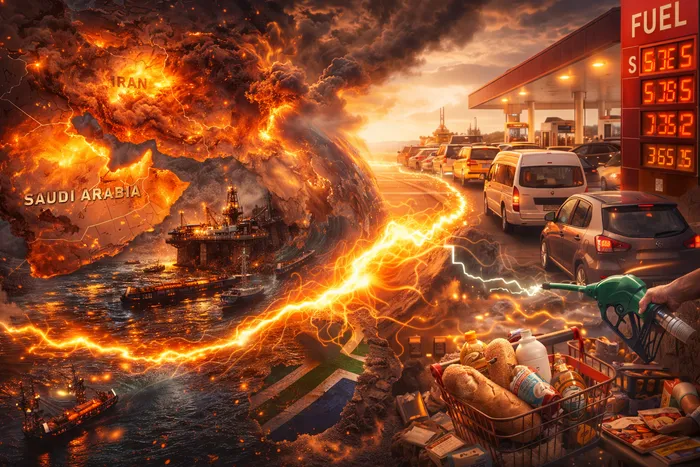
Expect to feel the effects of the war on Iran in your pocket.
Image: ChatGPT
South Africa could be staring down the barrel of a renewed fuel and inflation shock as military strikes by the United States and Israel on Iran send tremors through global energy markets. What may appear to be a distant geopolitical confrontation is rapidly translating into hard economic consequences: a weaker rand, rising oil prices and mounting inflation risks that could hit households and businesses within weeks.
The surge in oil prices is not incidental. It is rooted in the strategic importance of the Middle East to global energy supply. Iran remains a significant oil producer and is positioned alongside one of the most critical oil transit routes in the world, the Strait of Hormuz.
This narrow shipping corridor connects the Persian Gulf to international markets and carries a substantial share of globally traded crude oil each day. When conflict threatens this passage, markets react swiftly and often aggressively.
Oil prices do not only rise when supply is physically interrupted. They also increase when credible risks emerge that supply could be disrupted. Traders factor uncertainty into contracts. Shipping insurance premiums climb. Freight and logistical costs rise. Buyers begin securing supply at higher prices to hedge against potential shortages. Even the possibility of interference with exports can push global oil benchmarks sharply upward.
In the current environment, the concern is twofold: escalation could affect Iran’s oil production or exports, and hostilities could interfere with tanker movement through the Strait of Hormuz.
For oil-importing economies such as South Africa, this creates immediate exposure.
Economist Dawie Roodt
Image: File
Economist Dawie Roodt says the biggest question facing South Africa is how deeply the conflict will impact the country’s already fragile economic environment.
“While interest rates were on a downward trajectory, clearly there's going to be upward pressure on inflation, meaning that the petrol price will go up.”
Roodt says that pressure will ripple far beyond the petrol pump.
“For example, for agriculture, agricultural input like fertiliser prices are likely to go up, which will eventually be felt in an increase in food price inflation as well. So inflation likely to be the upper pressure inflation.”
Rising inflation typically complicates policy decisions for the South African Reserve Bank, particularly when it comes to interest rate adjustments.
Days before the escalation in the Middle East, Finance Minister Enoch Godongwana presented the national budget. “Just a week ago, we had the budget of the Minister of Finance. Things started looking as if things could improve on the fiscal side. Now, most of those numbers are probably going to be missing their target.”

Professor Raymond Parsons.
Image: File
Professor Raymond Parsons of the North-West University Business School says South Africa should not underestimate the potential fallout.
“Although it is still early days in the conflict, it is already evident that travel and tourism in the Middle East has been disrupted, with air flights having been cancelled on a large scale.”
He cautions that instability in the region raises broader concerns about the political and economic trajectory of the Middle East.
“The biggest immediate impact for countries like South Africa will inevitably be the elevated uncertainty about global oil prices, and hence the prospect of higher fuel costs in the months ahead. Oil prices are widely expected to spike in the short-term and stay high for a period - depending on the outcome of the war and in the absence of any new supply measures to offset higher oil prices.”
The freight and logistics sector is already absorbing the impact. Gavin Kelly, CEO of the Road Freight Association, says March’s diesel increase reflects the immediate consequences of rising international oil prices and logistical risk.
“The increase in fuel prices in March 2026 is a direct result of upward pressure on the international price of oil due to both supply and logistics risks following the start of hostilities between Iran and the US and Israel. The Road Freight Association (RFA) has noted with both dismay and concern, that the price of diesel is increasing between R0.60 and R0.65 per litre.”
Diesel underpins South Africa’s transport economy. When it rises, distribution costs climb rapidly and those increases cascade through supply chains.
“Transporters will be faced with - either immediately or later, depending on their operating models or agreements - factoring this increase (and any others that may arise) into their pricing when offering freight transportation services. This means that the gains which were achieved through the gradual reduction of the basic fuel price during 2025, will be erased and the consumer will, inevitably, begin to feel this change in increasing prices at the till.”

Gavin Kelly, CEO of the Road Freight Association
Image: Supplied
Financial markets have also already reacted sharply. Annabel Bishop, Chief Economist at Investec Bank Limited South Africa, says last weekend’s developments have altered risk calculations.
“The events in the Middle East over the weekend have resulted in an upwards revision in our severe down case probability, to 3% today from 2% previously, but at risk of rising further, depending on how events unfold this month.”
She notes that the rand has weakened as investors move toward the US dollar amid heightened geopolitical uncertainty.
“With the rand at R15.87/USD on Friday, and the oil price at US$72/bbl, or R1 156/bbl, there has been a 12% jump in the rand oil price, to R1 294/bbl, which if sustained, or rises further, would push up fuel prices in April in South Africa.”
For ordinary South Africans, the broader outlook remains troubling.
“And then for ordinary South Africans, it means weak economic growth again, which has been exacerbated by the wrong macroeconomic policies, high levels of unemployment and things like that,” Roodt said.
He adds that while the full economic fallout is still unfolding, the outlook has clearly become more fragile.
“So a lot of uncertainty, but certainly things are going to look a little bit worse and perhaps a lot worse going forward.”
tracy-lynn.ruiters@inl.co.za