

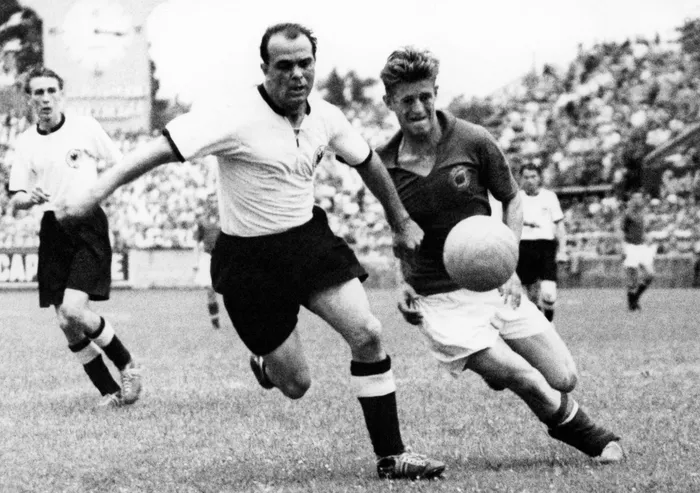
Werner Kohlmeyer, left, of West Germany fights for the ball during their 1954 Fifa World Cup match against Yugoslavia.
Image: AFP
The Cold War was beginning to freeze global relations, and the football world was about to witness the most high-scoring, chaotic, and technologically groundbreaking tournament of its era at the Fifa World Cup in Switzerland in 1954.
West Germany returned to the international sporting fold after their post-war ban was lifted, while Soviet Union countries chose to boycott the event entirely.
Several nations faced qualification hurdles, but the biggest storyline belonged to the unstoppable "Magical Magyars" of Hungary, who arrived on the back of a four-year, 32-match unbeaten streak and were universally expected to cruise to the title.
Due to the complex geopolitical climate, Argentina refused to participate for the third consecutive tournament, while internal disputes saw the likes of Egypt fail to make the trip — leaving the tournament with a final field of 16 teams.
Asia: South Korea
Europe: Austria, Belgium, Czechoslovakia, England, France, Hungary, Italy, Scotland, West Germany, Yugoslavia, Switzerland
North America: Mexico
South America: Brazil, Uruguay
Switzerland selected six venues across the country to host the tournament. The final was played in Bern at the Wankdorf Stadium, a ground that became immortalised in sporting folklore.
The tournament was also historic for being the very first World Cup to be broadcast on television — launching the global spectacle into the living rooms of fans across Europe.
Fifa introduced a bizarre and highly criticised group format for this edition. The 16 teams were divided into four groups of four, but each group contained two seeded teams and two unseeded teams.
Crucially, teams only played the two sides opposite to their seeding — meaning each country played just two group matches instead of three. If teams were tied for second place on points, a play-off match was held to determine who advanced to the quarter-finals.
The tournament marked the debut of South Korea, who became the first independent Asian nation to compete at a World Cup. Having endured a grueling journey that required multiple flights and military transport just to reach Switzerland, the exhausted squad faced the ultimate baptism of fire.
In their opening match, they came up against the legendary Hungarian side led by Ferenc Puskás. The Koreans were comprehensively dismantled — losing 9–0 to the clinical Magyars. They backed that up with a 7–0 defeat to Turkey to exit the competition, but their resilience in simply making it to Europe earned widespread respect.
But the match that produced the most goals was the quarter-final clash between Austria and Switzerland. The knockout fixture ended 7-3 in favour of the Austrians. This match is still the highest-scoring match in men’s Fifa World Cup history.
Hungary were overwhelming favourites to lift the trophy in the final, famously dubbed the "Miracle of Bern". They had already thrashed West Germany 8–3 in the group stages and quickly raced into a 2–0 lead within eight minutes of the final. However, the resilient Germans pulled off the greatest comeback in World Cup history — fighting back in torrential rain to win 3–2 thanks to an 84th-minute winner from Helmut Rahn. It shattered Hungary’s golden generation and gave post-war Germany a monumental moment of national pride.
The 1954 tournament still holds the record as the highest-scoring World Cup in history relative to its size. A staggering 140 goals were scored across just 26 matches — averaging an astonishing 5.38 goals per game. This goal-frenzy remains an unmatched benchmark that is highly unlikely ever to be broken in the modern era of conservative tournament tactics.