

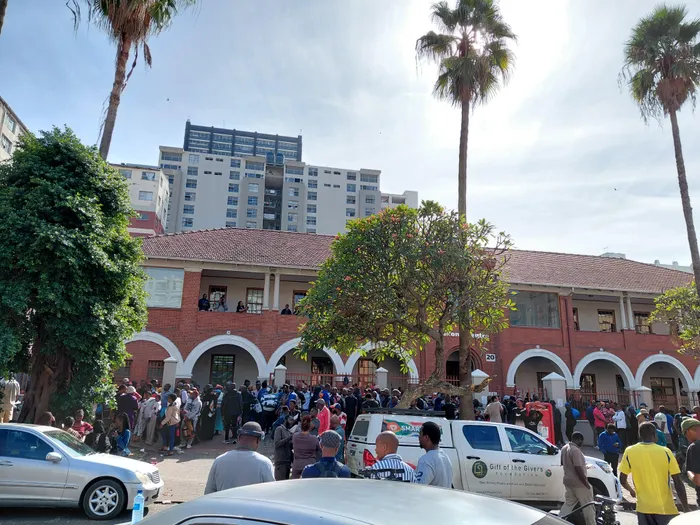
Families with children among those sheltering at Diakonia Centre amid uncertainty.
Image: XOLILE MTEMBU
After fleeing alleged threats and violence in their communities, scores of foreign nationals - including young children - spent the night sleeping on the cold floor at the Diakonia Centre in central Durban, seeking safety and shelter.
Wrapped in blankets and huddled together, families endured uncertainty and fear as humanitarian organisation, Gift of the Givers, stepped in to provide aid, including food, blankets, and essential support.
Amid the unfolding crisis, IOL spoke to some migrants, who shared accounts of alleged displacement, trauma and their desperate hope for protection in a country they had come to call home.
Among those sheltering at the Diakonia Centre was Christian Kwigomba, a refugee from the Democratic Republic of Congo (DRC), who said he fled conflict in his home country only to now face fear and uncertainty in South Africa.
"I'm from the eastern province of the DRC, where there is war involving M23. I'm here in South Africa as a refugee. I have been here for 15 years now," he said.
He said that he works as a barber to support his family. "I'm just a simple resident who works in a salon to survive. I'm a father of four children and have a wife."
But he said the current situation has left them feeling displaced and vulnerable.
"We're facing a very difficult situation right now in South Africa, where we are no longer able to live our daily lives and provide for our children.
"My wife and I have very young twins. Yesterday, they were taken to sleep in a church in Musgrave because there is no place for children."
Wivine Bahati, also from the DRC, said the group had been informed that the Department of Home Affairs would need to verify the status of those present before any intervention or assistance could be properly coordinated.
"We were told that in order for Home Affairs to intervene for our safety, they need to know the amount of people that are here who are legal and have their documents with them."
She explained that officials were expected to record names and conduct verification processes through relevant offices to determine legal status.
"Names will be taken from here to their offices and verify the status of the papers. This is because people are claiming that we have fake papers."
Bahati, however, strongly rejected allegations that those sheltering at the centre were undocumented, questioning the practicality and fairness of such claims under the current conditions.
"So, there are no undocumented foreigners here."
She further questioned how individuals alleged to be undocumented could present themselves for verification without risking detention. "If any person was in South Africa, how would they come here to get verified? They would get caught."
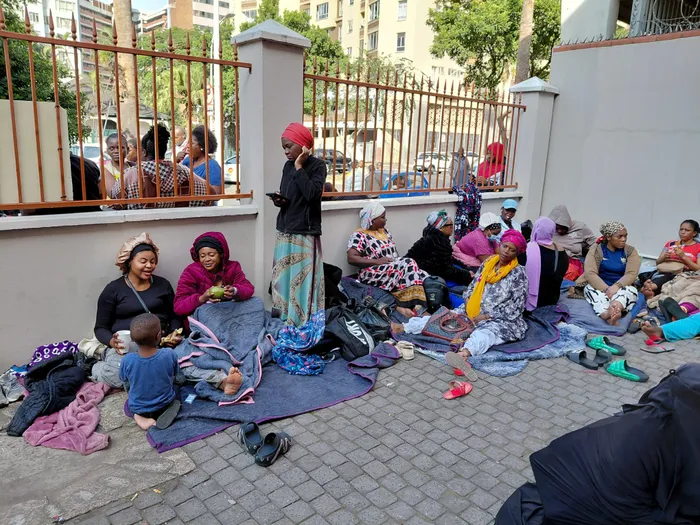
Displaced migrants sleep on Diakonia Centre floor as tensions escalate in Durban.
Image: XOLILE MTEMBU
Tensions around the centre even drew political and community attention, with Zamokuhle Mhlongo, a member of the Umkhonto weSizwe Party, also weighing in on the situation unfolding in the area.
Speaking to IOL, Mhlongo expressed concern about safety in the neighbourhood, linking the unrest to the presence of foreign nationals who have been sheltering in and around the centre.
"We have been here since yesterday because these foreigners are disrupting life in the area."
He claimed that residents felt increasingly unsafe, particularly in relation to women and children moving through the community.
"We believe it is no longer safe because children and women can no longer walk here."
Mhlongo further alleged disorder in the area and called for intervention from authorities and other stakeholders, urging that the situation be resolved urgently.
"These foreigners say they are not safe but what we're seeing is different. Yesterday, they were going up and down the street, drinking alcohol.
"We ask assistance from all stakeholders to solve this issue because illegal immigrants must go back to their countries. Our community is being abused. We are asking for help."
Bilall Jeewa, Community Liaison Officer for Gift of the Givers, said the organisation had been at the premises on Wednesday and came on Thursday morning to assist those sheltering at the centre.
"We are here today to provide support for the refugees that have been sleeping overnight."
He explained that aid had already been distributed the previous night, with particular focus on vulnerable groups.
"Last night, we were here, we distributed blankets, water and hot meals, especially for the mothers and children and females that are here."
Jeewa added that support efforts continued the following morning, with further food assistance provided as the situation remained fluid.
"This morning, upon arrival, we saw that they were still sleeping overnight, so we have eaten some tea and sandwiches this morning for them."
He further indicated that additional assistance was planned as the day progressed, with more food expected to be delivered later.
"And later on in the afternoon, we will try to get them some lunch as well."
Khethukuthula Shangase of the South African Communist Party said the aim of their engagement was to help find solutions that protect communities without escalating hostility toward migrants.
"What we have come here to do is to find a solution that will work for everyone," he said.
He stressed that the focus, in his view, should not be directed at migrants broadly, but rather at those who may be undocumented, while cautioning against collective blame.
"The battle we are fighting is not against the migrants but those who are in the country illegally."
Shangase warned that the situation risked fuelling xenophobia if not carefully managed, particularly where vulnerable groups are concerned.
"We want to make sure that it doesn't turn into hate against all migrants. Most of those that are here are documented."
He further argued that responsibility lay with broader systemic failures in migration management and border control, which he said had contributed to the current challenges.
"Hatred and violence should not be directed to all foreigners. It should be directed to the failed state or system that the government enabled. It did not fix our borders and migration system."
He also rejected stereotypes linking migrants to criminal activity, saying such narratives were harmful and misleading.
"Most of the people here are not drug dealers. Those criminals could be in areas like Umhlanga, and they are causing great damage in the country."
IOL News