


Corruption Watch (CW) today released its 14th annual corruption report, titled Ke Nako: Mobilising for justice on Monday. The report details the complaints it has received from across the country.
Image: File
Maladministration, fraud and bribery/extortion were the most common complaints reported to civil society body Corruption Watch last year.
This is according to the 14th annual corruption report, titled Ke Nako: Mobilising for justice released by CW on Monday.
The organisation said that in 2025, it received a total of 2 222 corruption complaints, 91% of which were corruption-related. This amounted to an average of 185 reports a month, with significant peaks and lows in certain months. The primary channels for reporting were the website (60%), followed by the dedicated WhatsApp channel (23%), with e-mail constituting 16% of reports.
According to the report, maladministration accounted for 408 cases, followed by fraud (330) and bribery/extortion (245). Other prevalent types of corruption included procurement irregularities (235), dereliction of duty (214), misappropriation of resources (209), and abuse of power (197).
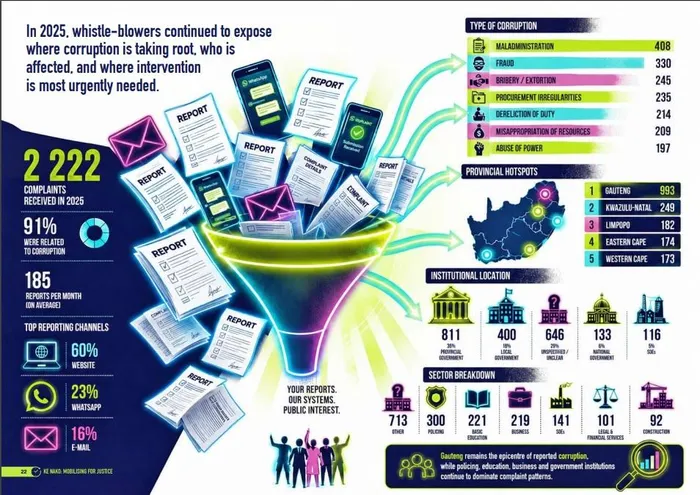
A graphic from the Corruption Watch's 14th annual corruption report, titled Ke Nako: Mobilising for justice, shows the complaints per province and sector.
Image: Screengrab from Corruption Watch report
Topping the list with the most complaints was the policing sector (300 reports), then basic education with 221 complaints. Third was business (219), followed by state-owned enterprises (SOEs) with 141, legal and financial services (101), construction (92), and traffic and licensing (82).
In terms of institutions, the highest number of reports (811) originated from provincial government entities, although many complainants chose not to identify them. In general terms, the South African Police Service is the most cited entity, followed by the education, justice, home affairs, and health departments.
In provincial terms, Gauteng remains the epicentre of reported corruption, with 993 cases and accounting for 45% of reports, with KwaZulu-Natal (249) in second place, followed by Limpopo (182), Eastern Cape (174), and Western Cape (173).
The report notes: “These five provinces collectively account for most reports, signalling a concentration of governance challenges in urban and economically active regions. At the municipal level, the City of Johannesburg leads with 480 cases, while City of Tshwane and Ekurhuleni follow with 259 and 174 cases respectively. Other notable hotspots include eThekwini Metropolitan Municipality (124) and City of Cape Town (12).”
“We have chosen the theme for this year’s annual report, Ke Nako: Mobilising for Justice because we recognise the imperative for our society to demand justice and accountability from those in power,” said CW board chairperson Themba Maseko.
We cannot leave it to law enforcement to fight the scourge of corruption alone, said CW executive director Lebogang Ramafoko, as this sector is itself compromised to a worrying degree. “The whole of society should be invested and involved in the fight against corruption.”
The full CW report is available here.
For more stories from The Mercury, click the link THE MERCURY