

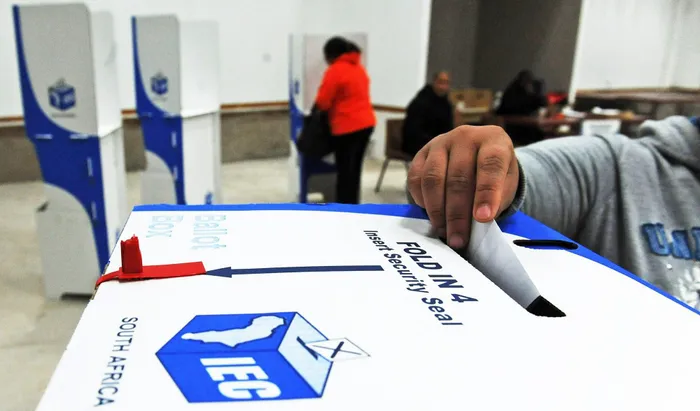
IEC voting station IEC CEO Sy Mamabolo says most new registrants are young people using the online portal.
Image: File
The Electoral Commission of South Africa (IEC) says more than 200,000 South Africans have registered to vote since November, with young people driving much of the increase.
The announcement comes ahead of the commission’s voter registration weekend on 20 and 21 June, which will see voting stations open across the country to make registration more accessible.
IEC chief electoral officer (CEO) Sy Mamabolo said the online registration portal had proven particularly popular with younger voters.
“I think younger people have an affinity towards the registration portal and are using it quietly to register themselves. A substantial majority of the 200 odd thousand people who registered since November is driven by young people,” he said.
Between November 2025 and March 2026, the IEC recorded 260,205 new registrations. Of these, 128,113 used voter management devices, while 132,092 registered via the online self-service portal.
Mamabolo said the trend was encouraging because research shows that once people are registered and vote, they are more likely to participate in future elections.
“Not only is it important for purposes of forthcoming elections because research tells us once a person is registered and votes, he tends to be a repeat voter. So it’s also, we do this with a view to the future as well,” he said.
The upcoming registration weekend will allow voters to register at stations closer to home, reducing barriers for those without online access.
“The idea is to open registration opportunities closer to where people live so that in a sense everybody has a fair access to the franchise process,” Mamabolo said.
While the exact date of the elections has not yet been set, IEC officials say the next local government elections must take place between 2 November 2026 and the end of January 2027.
Mamabolo explained that the final date will depend on practical considerations, including school and teacher exams and the December holiday period.
The official date will be proclaimed by the Minister of Cooperative Governance and Traditional Affairs Velenkosini Hlabisa, following the completion of voter registration.
Reflecting on the surge in youth registrations, Mbali Ntuli the founder and CEO of Ground Work Collective told IOL News that a combination of awareness and civic education had contributed to the trend.
“It is very encouraging to hear that since November over 200,000 people have registered to vote, particularly young people.
''I would like to think there’s a few factors driving this change and one of them is that young people are increasingly aware that many of the issues affecting their daily lives such as unemployment, service delivery, and access to education are directly shaped by political decisions,” she said.
She highlighted the impact of civic education initiatives, such as Ground Work Collective’s X-Change campaign, which engages schools, communities, and digital audiences to demystify the electoral process.
“When young people understand how governance decisions affect their communities, they are far more likely to register,” Ntuli said.
Ntuli said the surge reflects a shift in youth engagement, with frustration giving way to recognition of formal democratic participation as a tool for change.
“After participating in our civic education programs, we are seeing more young people asking informed questions about governance, local government, and how their vote can influence leadership choices. That suggests a more engaged and politically conscious youth,” she said.
She also acknowledged persistent challenges. Many young South Africans face socio-economic pressures, limited access to credible civic education, and a trust deficit with political institutions, all of which can hinder participation.
“Despite the generally positive outlook, several barriers still prevent many young South Africans from registering and participating in elections. When daily life is dominated by economic insecurity, participation in democratic processes can seem distant from the challenges people face,” Ntuli said.
However, she said increased registration offers reason for optimism. “In our experience at GWC, there is good reason to believe that increased youth registrations can translate into higher voter turnout.
''Registration alone does not automatically guarantee participation, but research shows that once young people are registered, they are far more likely to vote. In the 2021 local government elections, more than 70% of newly registered young voters participated,” she said.
To sustain youth engagement, Ntuli called for early and practical civic education, tailored outreach using digital platforms and community spaces, and transparent, accountable institutions that demonstrate young people’s participation matters.
“Young people need to feel their participation actually matters. Civic education must be practical, accessible, and ongoing.
''Institutions also need to meet young people where they are, using digital platforms, community spaces, and educational institutions to communicate in ways that are clear, credible, and relevant to their experiences.
''Finally, young people need to feel that their participation actually matters. Without trust in the democratic system, even the best registration campaigns will struggle to translate into sustained engagement,” she said.
hope.ntanzi@iol.co.za
IOL Politics