

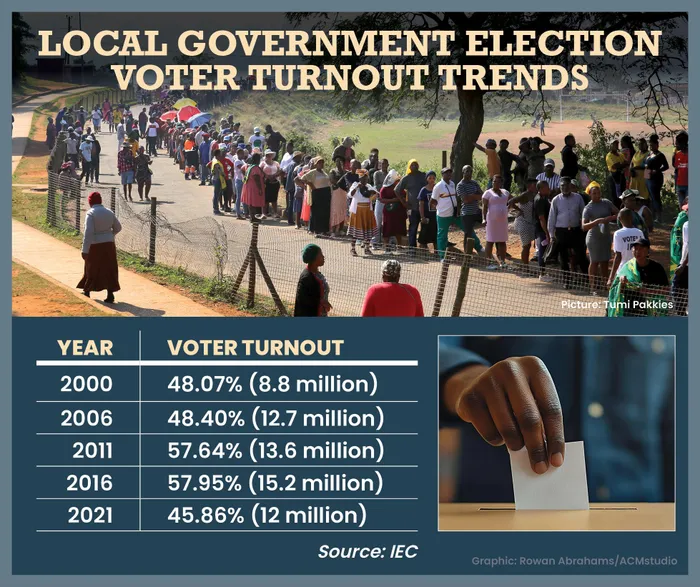
South Africa faces a steady voter turnout decline as the public grapples with poor service delivery.
Image: Rowan Abrahams/ ACM Studio
Voters are fed up with corruption, crime, unemployment, poor service delivery and are demanding enforced accountability, evidenced by the removal of incompetent leaders.
They say that the current political leaders in both local and national spheres lack the will to serve the public’s interests and improve service delivery.
Among the concerns raised by voters is that some ward councillors disappear from communities once elected to power, making it difficult for the public to access them.
Research conducted by the Human Sciences Research Council (HSRC) in 2023, revealed that deep discontent with democratic and leadership performance and harsh views of core political institutions, are significant factors that keep voters away.
The issue of discontent is again in the public discourse with political parties around the country intensifying their campaigns ahead of the 2026/2027 Local Government Elections. The country has, over the years, faced a steady decline in voter turnout in local government elections, with previous turnout (2021) dipping an all-time low of 45.86%.
Sèmanthe Combrink, a resident of Durban North, said there is deep frustration and a growing loss of respect for the government due to ongoing corruption and the failure to meet basic needs.
Combrink said that while communities are struggling with basic service delivery, unemployment, and daily survival, political leaders continue to engage in debates that do not translate into meaningful change on the ground.
“The problems we face are not because solutions don’t exist — they are the result of failed leadership and a system that has been weakened by corruption. When those entrusted with power act in their own interests instead of serving the people, even the best systems collapse. What we are seeing is not just inefficiency, but a serious lack of accountability and consequence for wrongdoing,” she said.
Combrink also called for accountability to be enforced with real consequences, where leaders who fail to deliver or are implicated in corruption are removed from power, not protected.
“There should be stronger mechanisms for communities to hold leaders directly accountable, including the ability to recall them. Transparency should not be optional. It must be mandatory, with clear reporting and visible outcomes,” she said.
Samuel Madire, a resident of Tshwane, said communities still struggle with basic service delivery, such as water and electricity.
“Our political parties are not serving the public’s interests. Our issues are infrastructure development, quality education, job creation, and improved overall service delivery.
He said the never-ending, unfulfilled promises by politicians to the voters appear as if they (politicians) do not know what they are doing.
“As South Africans, we suffer from an allergy to politicians’ lies. We all know that councillors only come to us when they need our votes. I wish we could have multiple Nelson Mandelas. He was always speaking in the true interest of the public. However, politicians nowadays just want to occupy political office, and when we need services, they are nowhere to be found,” Madire said.
He highlighted the need to implement lifestyle audits for everyone in public office or anyone who has access to the public purse.
“You cannot earn R50 and then live a lifestyle of R200. Where is the other money coming from? The tender system needs to be transformed or eliminated because it is being misused by self-serving individuals to the detriment of the public,” Madire said.
Sharon Olivier, a resident of Westbury in Johannesburg, said over the last decade, crime has increased, from daily robberies, hijackings, shootings of people, drug abuse, and unemployment.
"Everything is just getting worse by the day."
She said when she looks back to last year (2025), when there was a request from Westbury community members for the army to come in and assist with the gangsterism, drug lords, etc, this is done in the belief that “the justice system is failing us.”
“A lot of people have unanswered questions about certain cases within our area. I stay in Westbury, and we have a lot of social ills in our community, from unemployment to gangsterism to drugs and alcohol. So for us, it feels like we have a government that doesn’t care about the marginalised area or the marginalised race in our country. They are more worried about other people instead. We try to hold them (the government) accountable, but we are not getting any joy from all of this,” Sharon said.
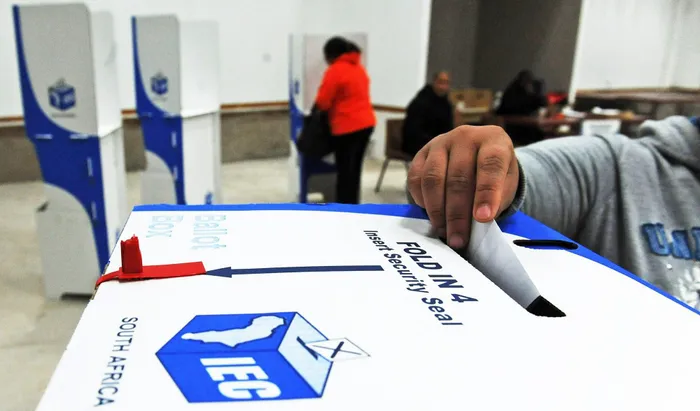
Communities are demanding stronger mechanisms to hold leaders directly accountable, including the ability to recall them from office if they fail to deliver.
Image: File
Ayesha Omarjee, a Durban resident, said the current political discourse is not representative of the current and future generations.
“As a lecturer at a university, I can understand the hardships of the students, who struggle to attend lectures because of no funding available to them, and their parents also don’t have money either. Some students sleep in libraries because they cannot afford to go home. This is extremely disheartening, and I think we have lost faith in these so-called political leaders,” Omarjee said.
She stated that there needs to be some form of accountability within the country’s political formations.
“Since I joined the workforce, I want to see where my tax money is going, especially when we hear allegations coming out of the Madlanga Commission, where billions are being stolen. We are hard-working citizens who ensure we put food on the table and bring our kids up in a safe and comfortable environment. Yet, we have politicians who are making us these promises, that we see nothing of,” Omarjee said.
"We need leaders who are stepping up to ensure that those found guilty face the full might of the law and not let go."
She said many of her colleagues and friends have emigrated, describing it as a brain drain because those individuals are educated, but their knowledge is now being used to benefit other countries instead of helping make a better South Africa.
Khazamula Chauke, a resident of Youth View Informal Settlement in Mamelodi (Tshwane) since 2016, said he will not vote in the upcoming local government elections, because the government is not taking people of lower status seriously and their concerns are ignored.
Chauke said his disappointment with the government started during the 2019 floods and worsened after the 2022 floods.
“We were promised relocation from Youth View Informal Settlement to a safer place, but this did not happen. In 2022, we were moved to a community hall. We stayed there for a year and a half, until we realised that nothing was going to happen; it is better that we go back to our shacks,” he said.
He added that they have not stopped engaging authorities, but it has all been in vain.
“I began voting in 1994, but after the 2019 and 2022 incidents, I chose to never vote again. Voting for me is not important anymore. We have tried everything in our power to get help from the politicians, but nothing has happened. From the time until today, we have been engaging with the authorities. They keep on promising, but nothing comes up,” Chauke said.
He added that he has come to realise that “this thing of voting doesn’t assist lower people like myself; it only works for those who are in higher positions".
Chauke said that the government must 'take our people seriously' and that councillors must help communities by listening, taking grievances to the higher-ups in the municipality, and reporting back.
“The only thing that would make me reconsider voting is if we are relocated to a place where there is service delivery, such as water and sanitation, and schools for our kids.
gcwalisile.khanyile@inl.co.za