

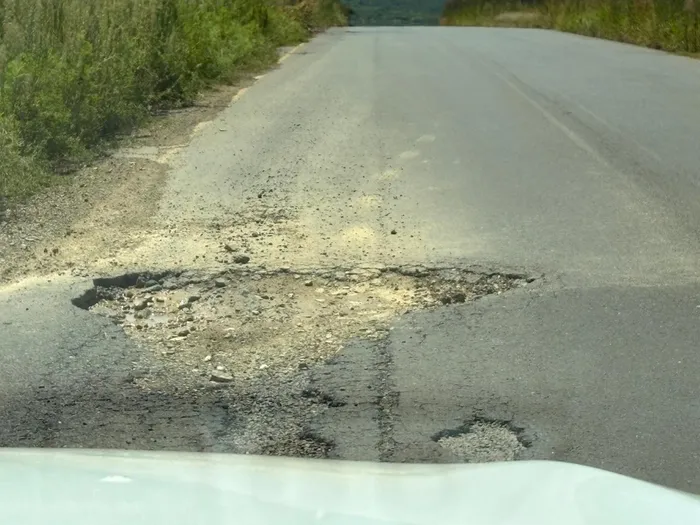
Most of the nearly 5,000 complaints logged on the CityMender app this year were about potholes.
Image: Supplied
Potholes and crumbling roads remain South Africans’ biggest service delivery headache, with water leaks and electricity faults ranking among the country’s most commonly reported infrastructure complaints, according to data from the CityMender app.
The app, believed to be the world’s first publicly deployed augmented reality feature for community service-delivery reporting, recorded more than 4,860 service delivery and infrastructure complaints since the start of the year.
The second most reported complaint category was water leaks and water-related infrastructure faults, followed by electricity outages and streetlight faults.
“Potholes and road-related defects remain the largest category on the platform. Road infrastructure directly affects safety, mobility, vehicle damage and economic activity, making it one of the most visible service delivery concerns for residents across South Africa,” said founder Keyuren Maharaj.
Maharaj, a University of KwaZulu-Natal mechanical engineering student, founded CityMenderSA out of frustration last year. Since then, the platform has rapidly grown into a widely used reporting tool for residents across the country and is now preparing for its first international expansion into Namibia.
“The platform has experienced substantial growth over the last four months as awareness has increased and new functionality has been introduced,” Maharaj said.
According to CityMender, around 2,400 of the approximately 4,860 reports logged this year have already been resolved or closed as fixed, giving the platform a resolution rate of roughly 50%.
“This represents a resolution rate of approximately 50%, which is encouraging considering reports span more than 30 municipalities across South Africa and cover a wide range of infrastructure categories.”
“The figure continues to improve as municipalities engage with the platform and residents confirm completed repairs, through our unique update feature.”
Response times vary depending on municipalities and the nature of the infrastructure fault.
Maharaj said electricity-related complaints in Durban and Cape Town often receive acknowledgement or reference numbers within 24 hours, while some outages are resolved within six to 36 hours.
“Residents consistently tell us that communication and updates are just as important as the repair itself. One of CityMender's primary goals has always been to improve transparency and close the communication gap between residents and service providers,” he said.
KwaZulu-Natal remains one of the app’s strongest regions, particularly within eThekwini Municipality where the platform initially gained traction. Cape Town has also seen steady usage, while Nelson Mandela Bay has experienced significant growth in recent weeks.
“We are currently focused on expanding awareness and adoption in Gauteng, which represents one of the platform's largest growth opportunities. Because CityMender supports every municipality in South Africa, we are increasingly seeing reports being submitted from a broader range of municipalities nationwide," Maharaj.
The platform has also begun integrating weather-related data with infrastructure complaints to identify links between severe weather and infrastructure failures.
“For example, during recent severe weather conditions in Cape Town, reports relating to flooding and blocked stormwater systems appeared on the platform alongside weather indicators, providing valuable insight into how environmental conditions affect infrastructure performance.”
“These findings are helping to shape what we believe will become South Africa's first independent predictive infrastructure intelligence model, using real-world service delivery data collected directly from communities," said Maharaj.
One of the app’s standout cases involved a major water leak in Durban that reportedly remained active for nearly a month. Using CityMender’s AI-powered analysis tools, the company estimated that close to 290,000 litres of water had been lost during that time.
“While the repair itself took time, the issue remained visible, tracked and regularly escalated through the platform until it was resolved. Without ongoing reporting and follow-up, the leak could potentially have remained active for much longer,” Maharaj said.
CityMender’s expansion into Namibia will officially launch on June 1 through a partnership with Namibian technology company Future Tech Computers.
“When we launched CityMender in South Africa, the goal was simple: make it easier for people to report infrastructure problems and track what happens next. What we didn't realise at the time was that every report was also creating valuable infrastructure data. Today, nearly 5,000 reports later, we're beginning to understand patterns that simply weren't visible before,” Maharaj said.
“Africa's future will depend heavily on how well we maintain, manage and invest in infrastructure. If CityMender can play even a small role in helping communities better understand those challenges and opportunities, then we believe the impact could extend far beyond a single municipality or even a single country.”