


Significant diesel price increases could be on the cards for May if the Middle East war does not end soon.
Image: AI / ChatGPT
South Africans were hit with unprecedented petrol and diesel price increases in April following a significant oil price spike caused by the war in the Middle East.
Although a R3-per-litre temporary tax reprieve alleviated some of the projected increases, motorists were still faced with a petrol price hike of R3.06 per litre and diesel increases of between R7.37 and R7.51. That pushed the wholesale price of 500ppm diesel up to R25.90 in Gauteng, with retail prices likely averaging R28 to R29 depending on the outlet.
But will we see R40 diesel prices in May as some sources have suggested?
Although that could be a worst-case scenario, the price increase is likely to be far less severe than initially projected if the Middle East ceasefire holds and international oil prices remain at their current levels of below $100 per barrel.
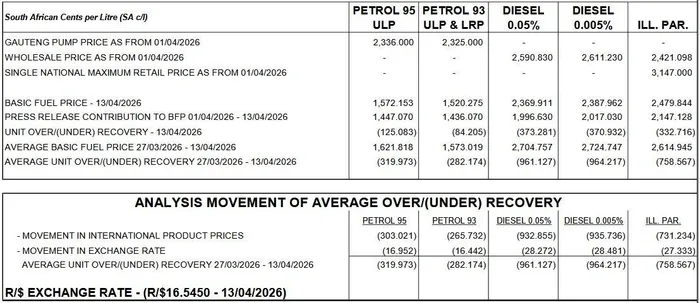
Latest CEF daily snapshot as released on April 14.
Image: Supplied
Although the latest data from the Central Energy Fund shows a significant average under-recovery for the month, which currently points to a diesel price increase of R9.61 for 500ppm diesel, the latest daily data shows an under-recovery of just R3.73. Much of that R9.61 figure was priced into the equation before the ceasefire.
According to our calculations, if oil prices remain at current levels, May’s diesel price increase is likely to be in the region of R6 per litre. However, any major developments in the Middle East could push things either way.
There is also the matter of the Treasury’s temporary R3 reduction in the General Fuel Levy, which it has hinted may be under review for extension. Assuming it is extended and that the ceasefire holds, South Africa’s diesel prices, at a retail level, are likely to average around R33 to R35 in May. Notwithstanding the fact that accurate predictions are difficult to make, given the political volatility in the Middle East.
On the petrol front, the CEF data is currently pointing to increases of between R2.82 (93 Unleaded) and R3.19 (95 Unleaded) for May, but once again, post-ceasefire data implies that these numbers could be reduced to around R1.80 if current trends persist.
The United States says Iran must now decide whether to move forward with efforts to end the conflict in the Middle East. This comes after weekend peace talks failed to produce a deal, although diplomatic efforts are still continuing.
A fragile ceasefire that was agreed to last week is still holding for the time being, and both sides have not completely closed the door on further negotiations. However, tensions remain high, with both the US and Iran blaming each other for the lack of progress.
The Strait of Hormuz, a key global oil shipping route, remains a major concern in the background. Despite the uncertainty, financial markets have remained relatively calm, and oil prices have eased slightly as hopes of a possible agreement continue.
Following April’s record increases, a litre of 95 Unleaded petrol currently costs R22.53 at the coast and R23.36 in the inland regions, where 93 Unleaded retails R23.25. The wholesale price of 50ppm diesel rose to R25.35 at the coast and R26.11 in Gauteng.
The above-mentioned under-recoveries related to the oil price could be further exacerbated by the Slate Levy, which compensated oil companies for over- and under-recoveries that took place in the preceding review period. This self-correcting mechanism is in place because while fuel prices are adjusted once a month, oil is bought and sold continuously.
IOL Motoring