

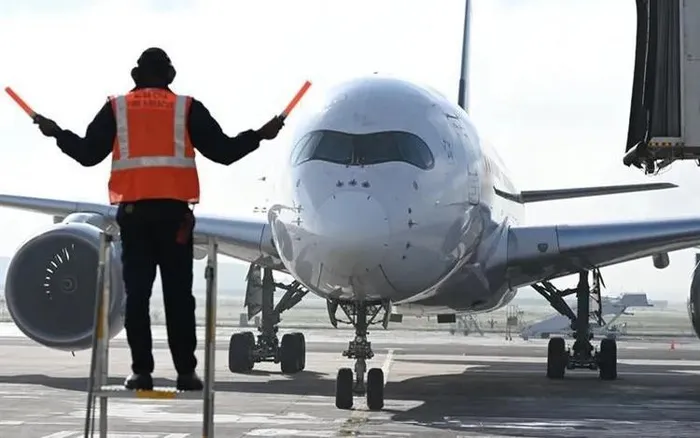
Dube TradePort wants to build private jet facilities at King Shaka International Airport in Durban.
Image: File
Durban is going all out to attract the ultra-wealthy by building infrastructure at King Shaka International Airport that could accommodate and maintain private jets.
Dube TradePort has revealed ambitions to build an airside zone that could accommodate a wide range of aviation operations, including hangars, offices, and maintenance facilities. The move has been described by the Durban business community as critical to the growth of the city.
Hamish Erskine, CEO of Dube TradePort Corporation, recently spoke at a business event about the plans surrounding this project.
In a statement, he highlighted the importance of the programme, stating that there are currently two projects in the planning stages around King Shaka International Airport. He said the first, led by Airports Company South Africa (ACSA), focuses on the development of a Fixed Base Operation facility to support business aviation. The second initiative is being driven by Dube TradePort Corporation and involves the establishment of an airside operations environment north of Dube TradeZone 1, which will accommodate private commercial aviation.
“The Airside Zone has always been a component of Dube TradePort's 50-year master plan and will now be moving into its implementation phase. The Airside Zone is planned to accommodate a wide range of aviation operations, including hangars, offices, and maintenance facilities. Dube TradePort plans to undertake the development over the next three years,” he stated.
“As Dube TradePort Corporation, we have already received interest from several private aircraft owners and operators seeking to establish these facilities. This growing interest is supported by strong market fundamentals,” he added. He emphasised that developing fixed-base operations alongside maintenance, repair, and overhaul facilities at King Shaka International Airport would provide valuable infrastructure for business aviation within KwaZulu-Natal.
He noted: “Business aviation plays a critical role in connecting remote and underserved regions, enabling access where scheduled commercial flights are limited, and supporting key sectors such as tourism, agriculture, and general investment.”
“By providing reliable handling, hangarage, and technical services locally, the province would build confidence among aircraft owners and operators, encouraging them to base and operate their aircraft in Durban,” he concluded.
Andrzej Kiepiela, coordinator of the KwaZulu-Natal Growth Coalition, stated that the business community is aware of and fully supports this initiative. He mentioned that it was part of the initial discussions that considered the relocation of the old airport to King Shaka International Airport. He also noted that this included discussions about relocating some operations from Virginia Airport; this facility could free up land at Virginia Airport for other development activities.
He emphasised that having such a facility is key to attracting top investors. “It is critically important to have this facility where business people can fly in, have a place for their planes, and access services,” said Kiepiela.
He remarked that while Durban is coming from a lower base compared to Cape Town, there are many projects emerging in the city, some already in the planning phases. Having such a facility will go a long way in helping those projects move at speed.
“We are expecting phenomenal growth in Durban over the coming eight years,” he stated.
Prominent Durban businessman Vivian Reddy said Dube TradePort’s move to develop private jet infrastructure at King Shaka International Airport is both timely and strategically important. “For a city like Durban, which has world-class lifestyle assets, coastal appeal, and growing mixed-use developments, the absence of proper private aviation facilities has long been a constraint.
“High-net-worth individuals and business leaders operate on efficiency, privacy, and convenience, and without the right infrastructure, Durban has simply not been competitive in that space compared to hubs like Johannesburg or even Cape Town.
“From personal experience, this has been a real limitation. I once owned a private aircraft, and when flying into Durban, the reality was that after dropping me off, the pilots had to reposition the aircraft to Lanseria International Airport due to the lack of suitable private hangar facilities locally.
“In addition, Virginia Airport has a runway that is not long enough to accommodate larger private jets. The resulting logistical inefficiencies and additional costs make it impractical for owners of larger aircraft to base or even regularly visit Durban. This new development changes that equation.”
He said, if properly executed, it could significantly impact both business travel and high-net-worth tourism.
For more stories from The Mercury, click the link THE MERCURY