

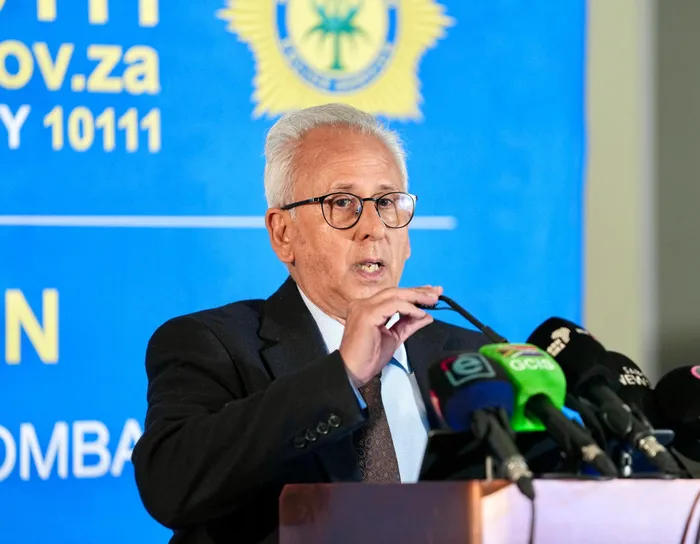
South Africa's crime statistics show a 9.5% drop in murders in early 2026, yet Police Minister Firoz Cachalia warns of persistent violence linked to domestic issues and organised crime.
Image: Supplied
South Africa recorded 546 fewer murders in the first three months of 2026, but Police Minister Firoz Cachalia warned that organised crime, domestic violence, and alcohol-fuelled attacks continue to leave communities living in fear.
Releasing the fourth-quarter crime statistics in Pretoria on Friday, Cachalia described the figures as “a stark mirror held up to our society.” He said each statistic represented traumatised victims and grieving families.
The latest crime data, covering January to March 2026, shows murders dropped by 9.5% compared to the same period last year, from 5,727 to 5,181 cases. Violent contact crimes overall declined by 4.6%, while house robberies fell by 20.4% and business robberies by 18.3%.
But despite the downward trend, Cachalia cautioned that South Africa still averages 58 murders a day.
“A decrease in crime is not the same as achieving safety,” he said. “The levels of violence and criminality in South Africa remain far too high.”
The minister used the briefing to spotlight what he called the country’s “deep-rooted culture of violence,” revealing that 1,523 murders occurred inside the home of either the victim or perpetrator.
Nearly half of all reported rapes 4,620 out of 9,782 cases, also took place in homes.
“Violence in South Africa is not only about strangers attacking strangers,” Cachalia said. “It is about partners, relatives, neighbours, and acquaintances.”
He linked much of the violence to interpersonal conflict, alcohol abuse, and vigilantism. Police data showed 898 murders stemmed from arguments and misunderstandings, while 299 were linked to vigilante attacks.
Alcohol was identified as a major driver behind violent crime, with more than 7,200 incidents of murder, attempted murder, rape, and grievous assault linked to alcohol use during the quarter.
Cachalia said the government was now considering tighter scrutiny of liquor licensing regulations and trading hours.
The minister also raised alarm over organised crime syndicates operating in the country’s economic hubs, particularly in Gauteng.
According to the statistics, Gauteng accounted for:
“These are not opportunistic crimes,” Cachalia said. “They are the work of organised criminal syndicates that are highly mobile, heavily armed, and deeply embedded in our economic centres.”
He warned that extortion rackets, including the so-called “construction mafia,” were spreading rapidly and undermining businesses, service delivery, and investment.
The minister announced a sweeping “police reset agenda” aimed at rebuilding public trust in the SAPS, strengthening investigations, and improving intelligence capacity.
As part of that plan, former SARS commissioner Edward Kieswetter will chair a new Police Advisory Panel tasked with overseeing reforms and advising the government on recommendations emerging from the Madlanga Commission.
Cachalia said the government would also explore a national community patroller programme that would deploy trained and vetted residents to patrol crime hotspots around schools, clinics, and transport routes.
He stressed that policing alone could not solve South Africa’s violence crisis.
“If we want to reduce violent crime, we must confront the culture of violence inside the home,” he said.
Closing the briefing, Cachalia addressed ongoing protests linked to illegal immigration, saying police would enforce the law “without fear or favour” while also protecting the constitutional right to protest.
“Our laws allow legal and not illegal immigration,” he said. “But they do not permit vigilantism, criminality, and chaos in public.”
For more stories from The Mercury, click the link THE MERCURY